
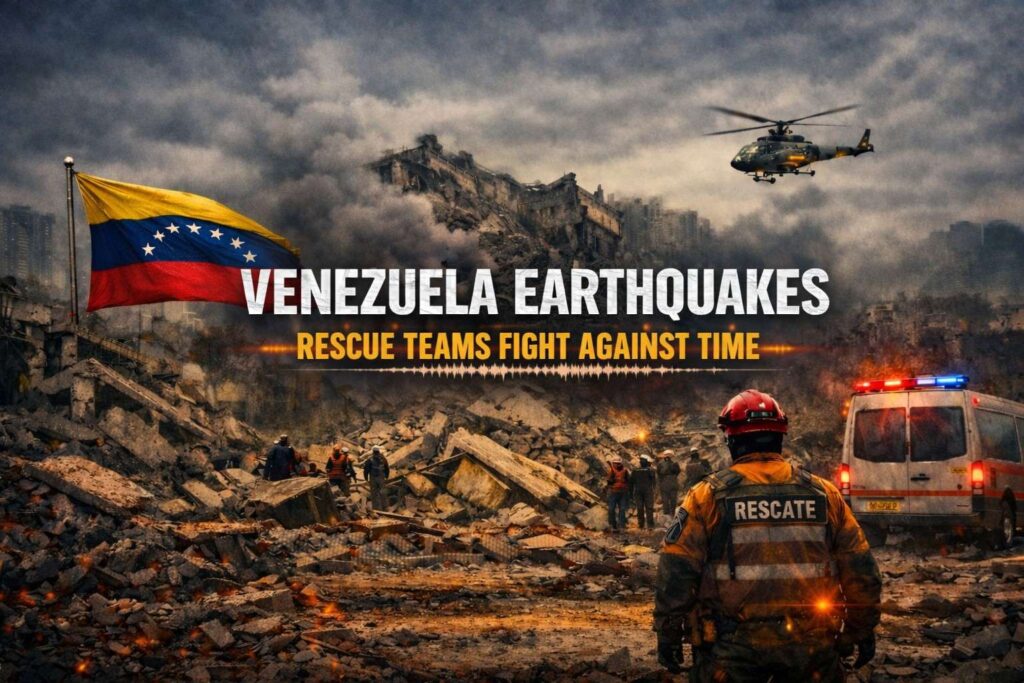
Controlling the Narrative: How Information, Access, and Aid Are Being Managed After the Venezuelan Earthquake
When a nation is struck by disaster, two battles begin at the same time: the fight to save lives, and the fight to control the story. In Venezuela, the earthquake has created a humanitarian emergency — but it has also exposed a struggle over who gets to speak, who gets to see, and who gets to know.
This article examines three converging elements:
- Restrictions placed on journalists and rescue teams,
- Verified cases of aid transports being exploited for contraband,
- Public accusations emerging from within Venezuela’s own institutions.
Each element reveals how fragile the truth becomes when access is limited and transparency is controlled.
- Restricted Access for Journalists and International Media
A verified news report from La Carlota describes strict new rules for national and international press. Journalists were required to register with government authorities and provide passport numbers, work credentials, blood type, contact information, and emails. International reporters were told they would receive visas “in the coming hours or days,” with no clear timeline.
They were also issued wristbands that must be worn until leaving the country.
Most importantly, journalists were informed that they may only enter disaster zones using government‑provided trucks with limited seating and fixed schedules. Independent movement is no longer permitted.
As one reporter stated:
“Solamente vamos a poder entrar a los lugares de desastre… a través de esos camiones que el gobierno va a proporcionar.”
This means:
- The government controls when journalists arrive,
- Where they go,
- How long they stay,
- Who they can speak to,
- And what they can see.
In a disaster, access is truth. Restrict access, and you restrict truth.
- Aid Transports Used to Move Contraband: A Verified Case
Separate from the media restrictions, a confirmed incident in Falcón state revealed that a truck labeled as humanitarian aid — carrying water bottles for earthquake victims — was secretly transporting 766 packages of marijuana in a hidden compartment.
This is not an allegation. It is a documented seizure by Venezuelan authorities.
It demonstrates:
- Criminal networks infiltrated the humanitarian supply chain,
- Aid transports can be used as cover for contraband,
- The urgency and chaos of disaster logistics create vulnerabilities.
Humanitarian vehicles operate with lower scrutiny, fixed routes, and political sensitivity. These conditions make them ideal for smuggling — inbound or outbound.
This single verified case shows that the narrative of “aid arriving smoothly” exists alongside a hidden reality: aid channels can be exploited.
- Public Accusations From Within Venezuela
Two widely circulated videos — provided as transcripts — contain allegations made by individuals claiming to be connected to Venezuelan police structures. These statements are personal accusations and must be independently verified, but they reflect the internal tension and distrust emerging during the crisis.
Key claims include:
- That certain officials are using police structures to move drug shipments out of La Guaira,
- That humanitarian vehicles and aid materials are being used to camouflage “polvo blanco,”
- That rescue teams are being blocked from entering certain zones,
- That demolition of structures is being ordered prematurely,
- That honest police officers are being urged to take control of their institutions.
Example line from Transcript 1:
“Están sacando lanchas de droga por los diferentes sitios de La Guaira.”
Example line from Transcript 2:
“Está usando los vehículos que se usan las ayudas humanitarias… para camuflajear y pasar el polvo blanco.”
These are allegations, not verified facts. But they illustrate how, when transparency is limited, competing narratives erupt — from citizens, from institutions, and from those who feel silenced.
- The Core Issue: When Access Is Controlled, Narratives Compete
The Venezuelan earthquake has created two parallel realities:
The official reality:
- Aid is flowing,
- Journalists are organized,
- Rescue operations are coordinated,
- Movement is regulated for safety.
The unofficial reality:
- Journalists are restricted,
- Rescue teams are blocked,
- Aid transports are vulnerable,
- Citizens and police insiders are raising alarms.
When the government controls transportation, access, and information flow, it also controls the narrative. And when the public feels that narrative does not match what they see, alternative narratives emerge — loudly, emotionally, and sometimes chaotically.
- Why This Matters
Disasters demand clarity. They demand trust. They demand transparency.
When journalists cannot move freely, when rescue teams are delayed, when aid transports are compromised, and when citizens feel compelled to record denunciations on their phones, the narrative fractures.
And in that fracture, truth becomes harder to find.
The Venezuelan people deserve a narrative that reflects reality — not one shaped by access restrictions, not one distorted by criminal infiltration, and not one drowned out by political noise.
In moments like these, the story of a nation is not written by those who speak the loudest. It is written by those closest to the rubble, closest to the aid trucks, closest to the truth.
And their voices must be heard.
Comments